
Manual Small Incision Cataract Surgery (MSICS) is a self-sealing, fast-healing surgical procedure used to remove advanced cataracts. It’s the simplest, most cost-effective treatment for cataracts by a significant margin.
Due to this technique’s low material cost, the primary barrier to its use is typically just knowledge of it. That’s why in 2006, SEE began facilitating MSICS courses through our education program so we could take part in training the next generation of humanitarian ophthalmologists.
MSICS Level 1 and Level 2
The MSICS courses SEE coordinates are categorized as Level 1 and Level 2. Level 1 courses introduce participants to MSICS in a wet lab.
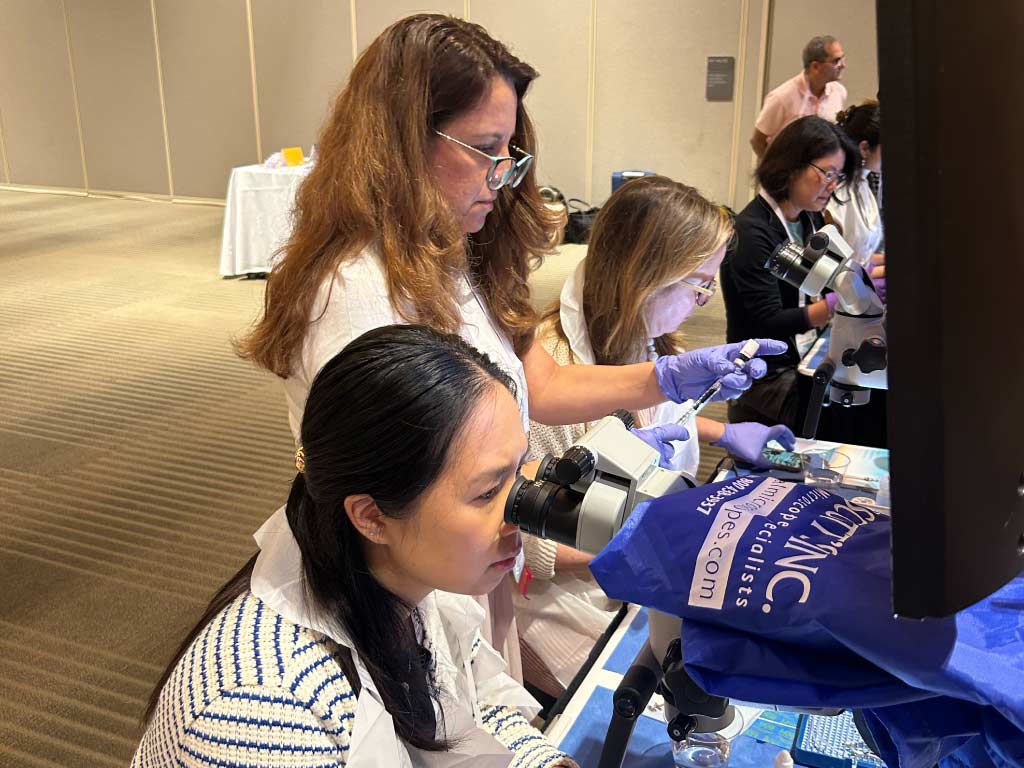
“We have our Level 1 course, where we go to conferences or we go to institutions, and they practice on porcine eyes with our microscopes, with our technicians, and some supplies,” said Gina Fernandez, SEE’s Education & International Programs Coordinator.
Depending on the event, a Level 1 course can have anywhere from 8 participants to more than 50. SEE also offers Level 2 courses for participants who have already completed a Level 1 course or another wet lab.
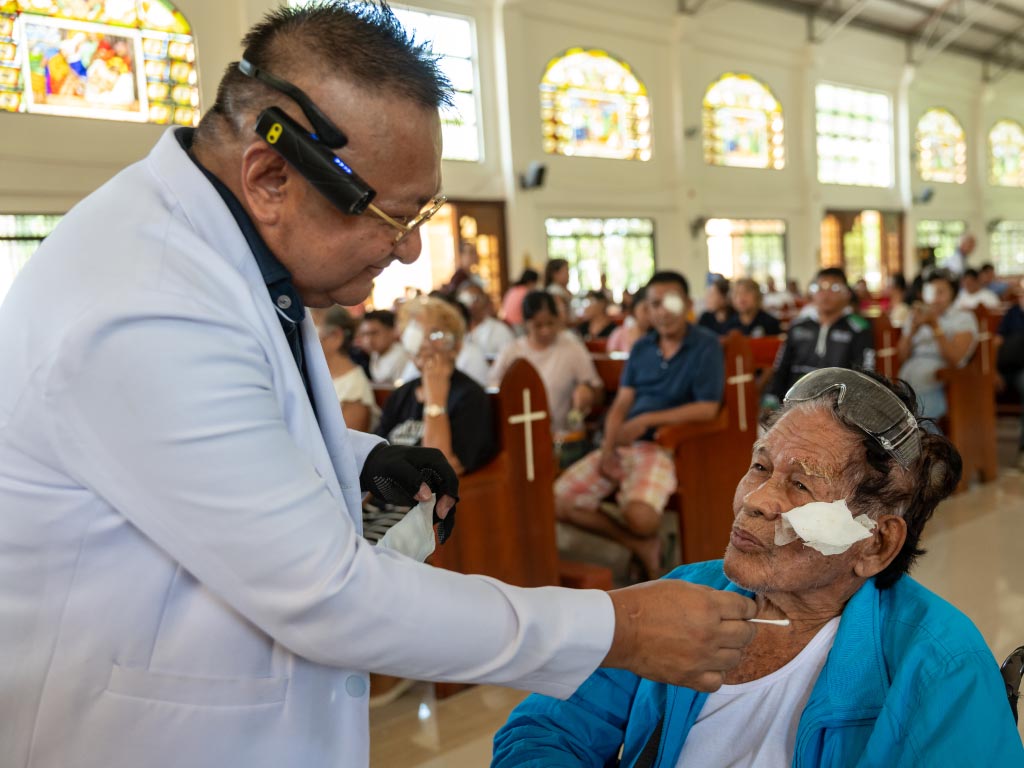
“For our Level 2 courses, participants are able to go in person with one of our international host doctors and practice on live patients with the guidance of the host,” Gina said.
These Level 2 courses generally allow participants to complete 20 to 25 cases.
Bringing MSICS Training to Ophthalmology Conferences
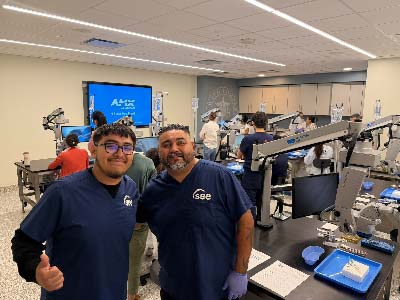
SEE often coordinates MSICS Level 1 courses at major professional conferences, where exposure to large and diverse audiences can significantly expand the reach of surgical education programs. Engaging participants across multiple stages of training helps build a sustainable pipeline of surgeons familiar with cost-effective cataract surgery techniques suited for high-volume programs in low-resource settings.
This year, SEE held Level 1 courses at the Global Ophthalmology Summit (GOS) and the Women in Ophthalmology Symposium (WIO). Bringing these courses to an ophthalmology conference takes coordination between SEE staff, instructors, conference organizers, and the host institution. The team works through the details ahead of time, including the space for the wet lab, equipment, supplies, microscopes, instrument trays, and the number of participants expected.
When the conference date arrives, the team assists in setting up the microscopes, preparing the porcine eyes for practice, and laying out instrument trays, while technicians make sure everything is ready before participants begin.
Building Connections Among Eyecare Professionals
These wet labs give SEE physicians and staff a chance to meet ophthalmologists they may not have worked with before. Participants can learn about SEE’s programs, talk with surgeons already involved with the organization, and connect with others interested in MSICS and humanitarian ophthalmology.
Those connections have helped SEE build relationships with other organizations and find new opportunities to offer training. For instance, one of SEE’s regular MSICS instructors, Mateen Amin, helped put SEE in contact with representatives at WIO, leading to our facilitation of MSICS Level 1 courses at their conference for the first time this year.
“Mateen is a longtime champion of SEE and has been willing to support in building those connections,” said Gina.
Other conferences and institutions often reach out to SEE about being considered for future courses.
“It really is a popular initiative that we have,” she added.
Learning Alongside Experienced Surgeons
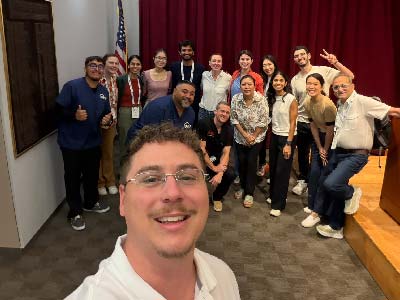
Level 1 courses held at conferences like this can reach ophthalmologists at different points in their careers, including medical students who have not seen an eye operation before. And learning MSICS early in their careers often inspires up-and-coming ophthalmologists to consider volunteering for international humanitarian work.
“We sometimes get med students who will see an eyeball actually get operated on for the first time,” said Scott Glass, SEE’s Lead of Education & International Programs.
“Exposing them to this technique early makes a difference in whether they consider joining volunteer efforts. It makes them think to themselves ‘Oh, you know what, I want to for sure do this, and I want to do international work.’”
2026 GOS and WIO: Thank You to Instructors
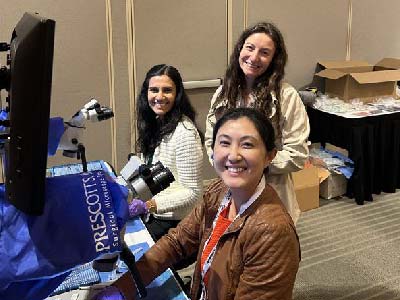
Many eyecare professionals were trained during the Level 1 courses held at the Global Ophthalmology Summit and Women in Ophthalmology conferences this year. At GOS, a total of 50 participants were trained by 17 instructors, which included Dr. Maria Heyrosa, Dr. Nathaniel Gebhard, Dr. Aishwarya Sriram, Dr. Michelle Sun, Mateen Amin, Dr. William Myers, Dr. Otana Jakpor, Dr. Aditya Sudhalkar, Dr. Sheena Song, Dr. Jude Stern, Dr. Brenton Finklea, Dr. Sanika Udyaver, Dr. Eliza Barnwell, Dr. Kevin Barber, Dr. Santi Karnam, Dr. Brad Feldman, and Dr. John Anhalt.
Scott mentioned that he particularly liked seeing participants at GOS become so excited about learning MSICS that they didn’t want to leave once the course concluded:
“Participants get really excited about it. Whether they signed up weeks in advance or the day of, you’ll see some people take the course and they don’t want to leave. They don’t want to get up. They want to keep doing it, getting another eye if they can, or asking if they could sign up for another session. So, it’s cool to see people get really excited about it,” he said.
At WIO, a total of 16 participants were trained by four instructors, including Mateen Amin, Dr. Julibeth Alvarez, Dr. Katherine Joltikov and Dr. Rachel Scott. The SEE team extends a special thank you to all of the wonderful instructors who volunteered to teach these courses, as their efforts are expanding the pool of doctors equipped to restore sight in humanitarian settings.
Taking the Skill into Humanitarian Eyecare
These education initiatives are an investment in the surgeons who will go on to help expand access to cataract care in the future. Gina sees MSICS training as a vital part of our mission, as it ultimately brings us closer to a world where treatable blindness no longer exists, and high-quality eyecare is accessible to all.
“If we provide education and these future surgeons have the capacity to understand and really hone this skill, they could be traveling for humanitarian work annually. It really is a beneficial skill for traveling surgeons to have, and it’s a great opportunity for SEE to offer as a stepping stone and introduction to this world of restoring sight,” she said.
Donate today to support more education initiatives like this!